Best Puppy Chew Toys for Teething: 5 Picks Reviewed

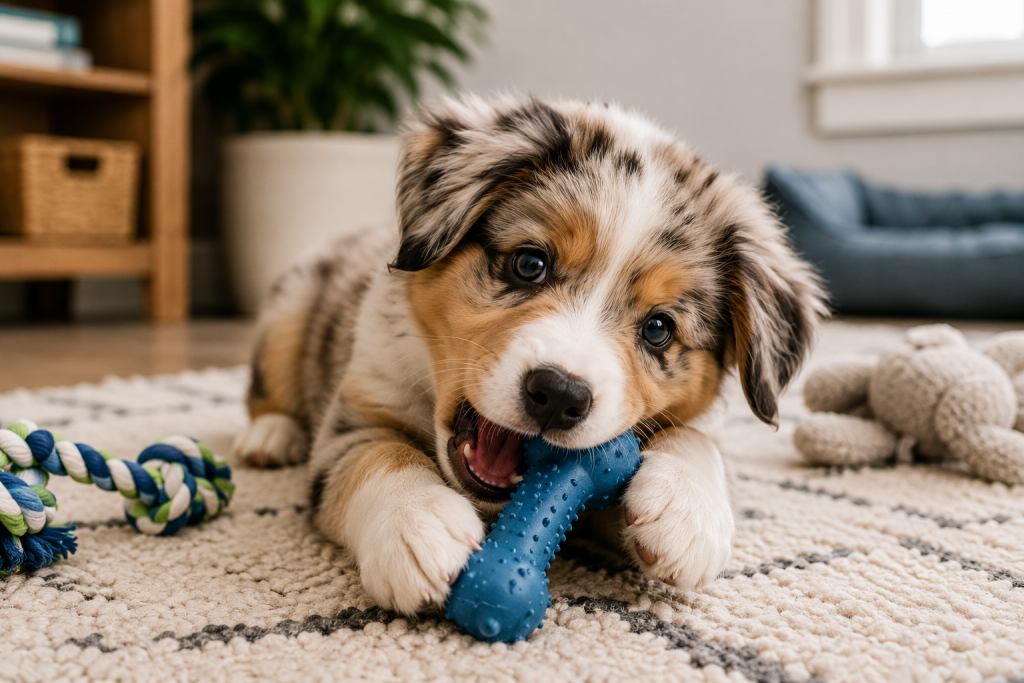
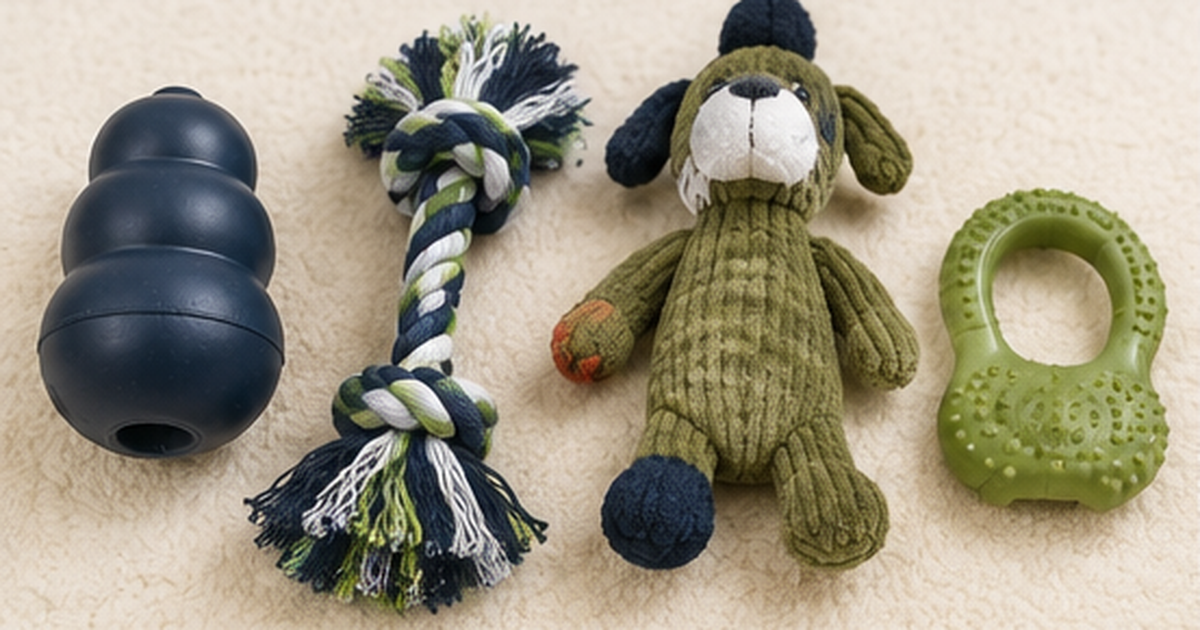
Collection of puppy teething toys in different textures

This post contains affiliate links. If you buy through one, we may earn a commission at no extra cost to you. See our Affiliate Disclosure for details.

Written by the Puppy Tackle team — we’ve spent time on the retail and Amazon marketplace side of the pet products industry before starting this site, and we bring that same “does this actually hold up” scrutiny to every pick here.

Our Puppy Starter Kit guide covers the basic idea: teething starts around 3-4 months and it doesn’t stop until it stops, so the goal is redirecting the chewing, not fighting it. The AKC’s guide to puppy teething and nipping is a good primer on the timeline and why it happens, if you want the full picture before you start shopping. Here’s which specific toys actually do that job, by texture and situation.

What We’re Judging On — Durability against a determined chewer, safety (no small parts that break off), whether the texture actually appeals to a teething puppy specifically, and if it’s easy to clean.

Best for Sore Gums: Freezable Rubber Teether — Cold soothes inflamed gums the way ice helps a human toothache. Good for the peak teething window (3-4 months), especially fussy evenings. Trade-off: needs freezer lead time. [AFFILIATE: Freezable rubber puppy teether — Amazon]
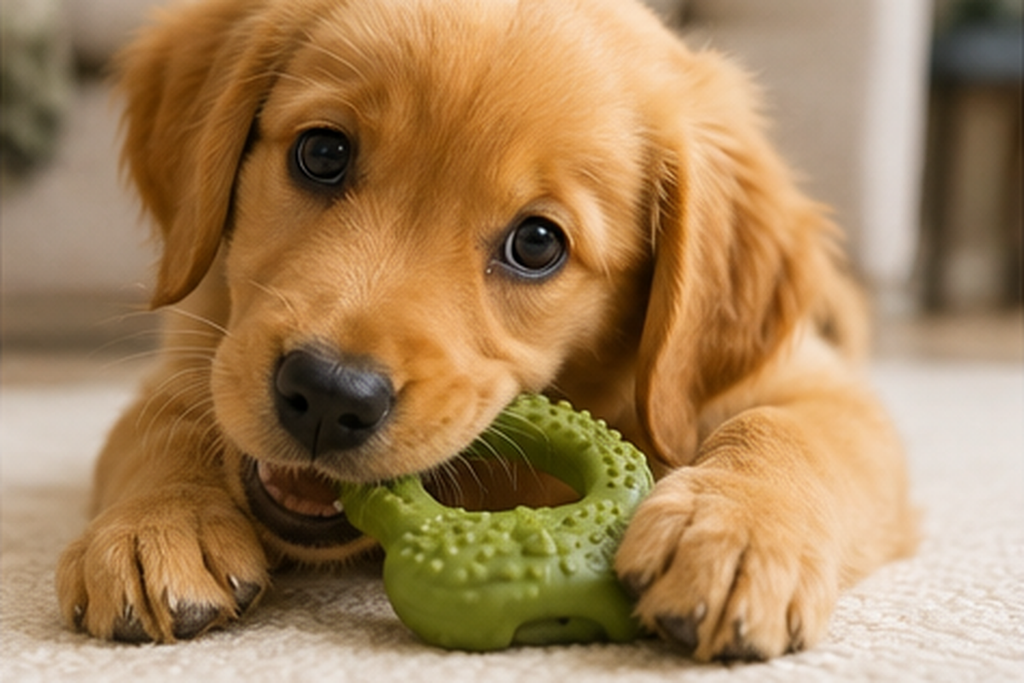
Best All-Around: Textured Rubber Chew Toy — Varied ridges, holds up better than soft materials to daily use. Trade-off: aggressive chewers can wear through it — check regularly. [AFFILIATE: Textured rubber chew toy — Amazon]

Best for Interactive Play: Rope Tug Toy — Doubles as chew outlet and tug game, good for puppies who nip during play. Trade-off: fraying fibers can be swallowed — retire at first sign of unraveling. [AFFILIATE: Rope tug chew toy — Amazon]

(image 10c: new rope toy next to a frayed one, showing when to retire it)

Best for Independent Chewing: Stuffable Rubber Toy — Stuff with food/filling, useful during crate training or alone-time practice. Needs supervision early on. [AFFILIATE: Stuffable rubber chew toy — Amazon]

Best for Small/Toy Breeds: Soft Plush Squeaker (Chew-Adjacent) — Sized right for smaller mouths and less bite force. Not for determined destroyers — swap at first torn seam. [AFFILIATE: Small-breed plush chew toy — Amazon]

What to Skip — Rawhide (choking/blockage risk); anything with small detachable parts (squeakers, plastic eyes); adult-sized toys on a young puppy.

When to Retire a Chew Toy (Don’t Wait for “Almost Gone”) — Check the rotation every couple weeks for fraying/unraveling rope, cracks or bite-through spots on rubber, loose seams on plush. Rule of thumb: if you’re asking “is this still okay?”, it isn’t. A 2-3 toy rotation makes this easier than running one toy to failure.

What This Actually Costs — Roughly $20-$40/month during peak teething (3-6 months), tapering after. Full picture in How Much Does It Cost to Own a Puppy?

FAQ

  • How many toys in rotation? 2-3.
  • Puppy ignores the toy and chews furniture instead? Try a different texture; redirect actively a few times.
  • When does teething end? Mostly by 6-7 months, though breed-level chewing drive can persist as personality, not teething.
  • Is a little blood while teething normal? Yes, from a loose baby tooth. Ongoing bleeding, swelling, or not eating — call the vet.

This post is general information, not veterinary advice. If your puppy is chewing unusually aggressively, seems to be in pain, or you suspect they’ve swallowed something they shouldn’t have, contact your vet right away.

Need the rest of the starter gear list? See our Puppy Starter Kit guide for crates, bowls, and grooming basics.
Best Puppy Harnesses: 4 Picks Reviewed

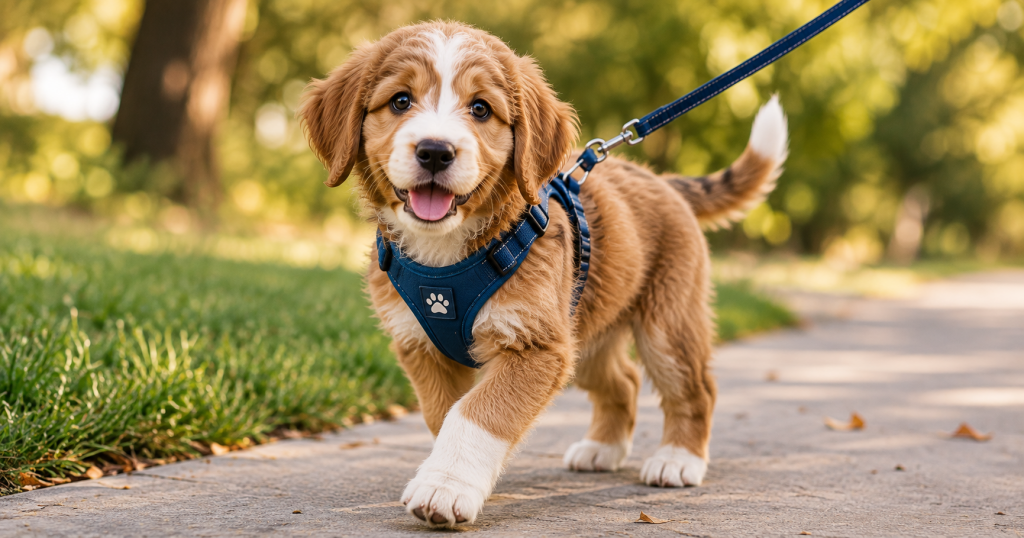
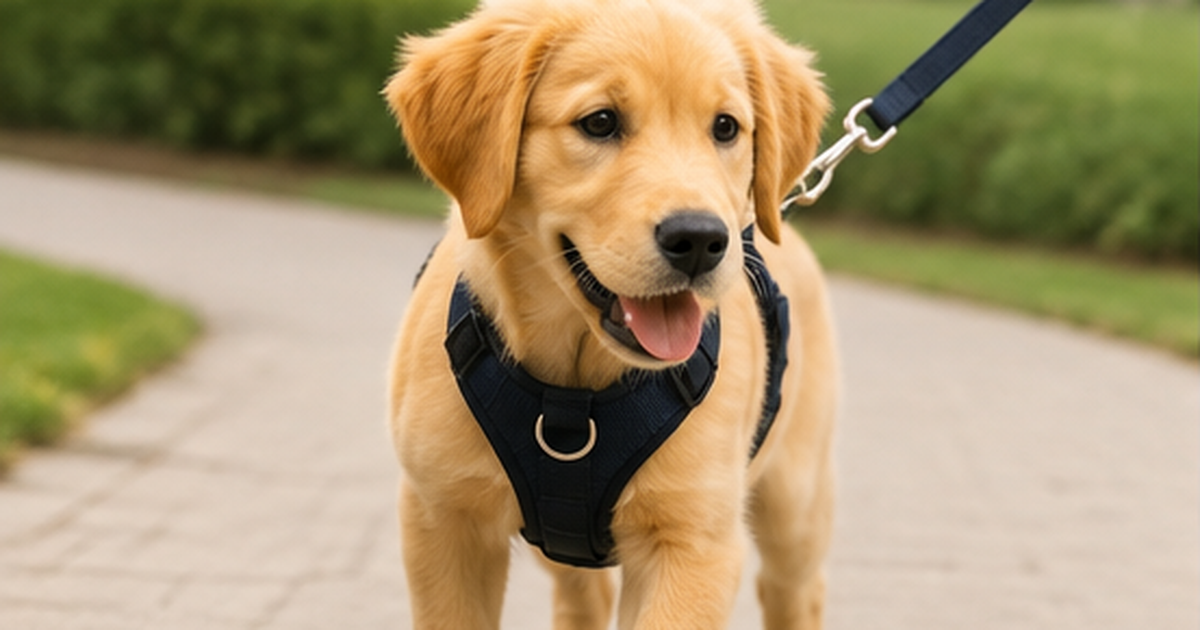
Puppy wearing a properly fitted harness on a walk

This post contains affiliate links. If you buy through one, we may earn a commission at no extra cost to you. See our Affiliate Disclosure for details.

Written by the Puppy Tackle team — we’ve spent time on the retail and Amazon marketplace side of the pet products industry before starting this site, and we bring that same “does this actually hold up” scrutiny to every pick here.

Our Puppy Starter Kit guide explains why a harness beats a collar for walks — it takes pressure off a puppy’s developing neck and trachea, and gives you more control if they lunge. VCA Animal Hospitals has a good collar vs. harness breakdown for puppies if you want the full veterinary reasoning behind that advice. This is the specific-picks version: which harness for which situation.


What We’re Judging On

Fit adjustability (puppies grow fast, and a harness with limited adjustment range gets outgrown in weeks), material and stitching quality at pressure points, ease of putting on a squirmy puppy, and whether it actually helps with pulling rather than just repositioning it.


Best Overall: Step-In Adjustable Harness

Step-in styles are the easiest to put on a wiggly puppy — no lifting legs through loops, no wrestling a vest over their head. Multiple adjustment points mean it keeps fitting through several growth spurts before you need to size up.

Good for: most puppies, most owners, especially anyone still working on getting their puppy comfortable with handling.

Trade-off: less structured support than a vest-style harness for a puppy that pulls hard.

Step-in adjustable puppy harness

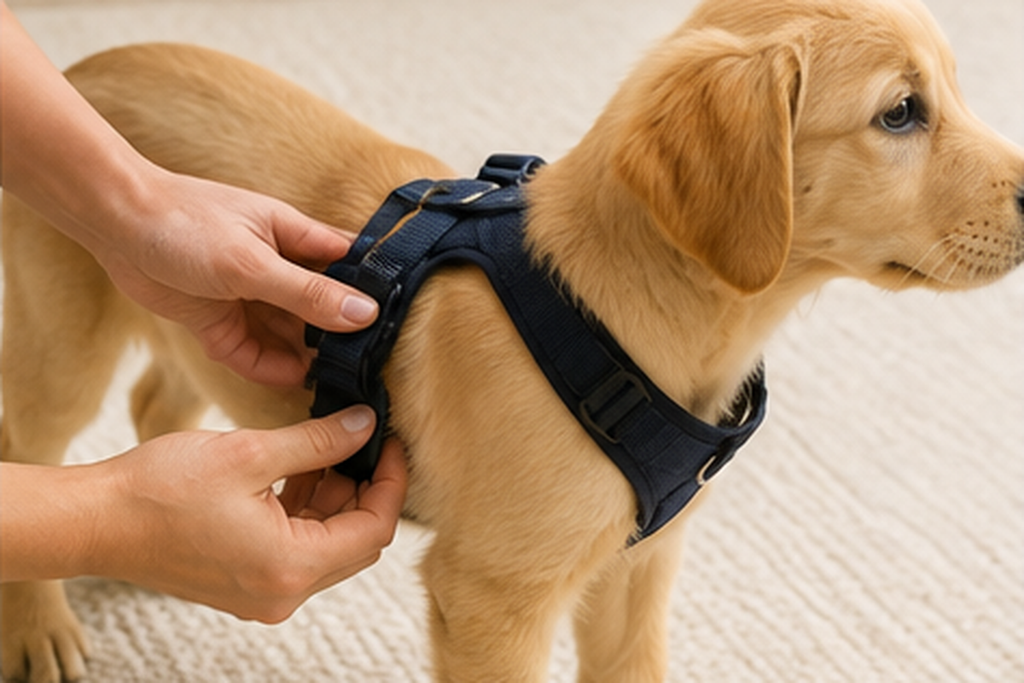
Puppy being fitted into a step-in harness


Best for Pulling: Front-Clip Harness

Attaching the leash at the chest instead of the back changes the physics of a pull — instead of powering forward, a pulling puppy gets gently redirected sideways, which makes loose-leash walking easier to teach without any aversive tools.

Good for: puppies who lunge at other dogs, squirrels, or literally anything; anyone actively working on loose-leash walking.

Trade-off: the front strap can rub if it’s not sized correctly, so double-check fit more carefully with this style.

Front-clip no-pull harness

If you’re dealing with pulling that goes beyond what a front-clip harness solves on its own, PetSafe makes some of the most trusted training and containment gear in this category — worth a look alongside a harness, not instead of one.

PetSafe training gear

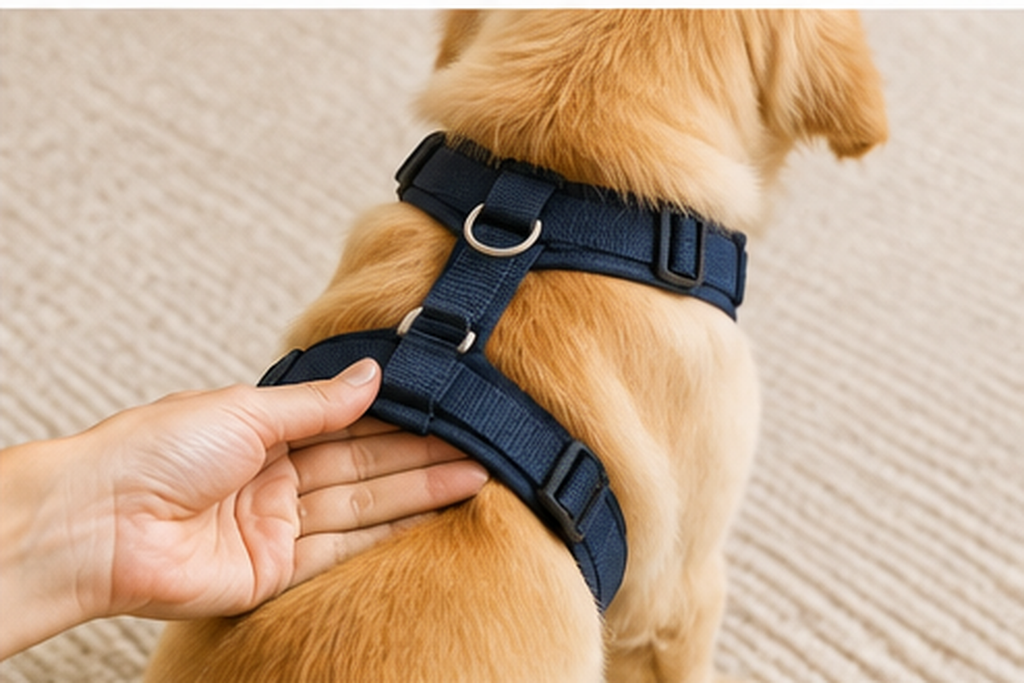
Checking harness fit with the two-finger rule on a puppy


Best for Tiny Breeds: Mesh Vest Harness

Small and toy breeds have more delicate tracheas and ribcages, and a soft mesh vest distributes pressure more evenly across the chest than a strap-style harness. It’s also generally more comfortable for short walks in cold weather since it covers more of the body.

Good for: toy and small breed puppies under roughly 15 lbs.

Trade-off: less durable under heavy pulling than a strap-style harness — not the pick for a strong or high-energy small breed.

Mesh vest puppy harness


Best for Growing Breeds: Fully Adjustable Multi-Point Harness

For large-breed puppies who’ll roughly double or triple in size over the first year, a harness with adjustment at the neck, chest, and belly gets significantly more mileage before it’s outgrown.

Good for: large and giant breed puppies, or any owner who wants to buy one harness and adjust rather than replace it every couple of months.

Trade-off: more straps means more time getting the fit right the first few times.

Multi-point adjustable harness


Getting the Fit Right

You should be able to fit two fingers, flat, between the harness and your puppy’s body at every strap — snug enough that they can’t back out of it, loose enough that it doesn’t restrict a full range of motion. Recheck fit every couple of weeks during a growth spurt; a harness that fit perfectly a month ago can be too tight faster than you’d expect.


Common Mistakes That Lead to Rubbing, Escape, or Injury

Most harness problems come down to one of these:

Sizing it for “now” instead of checking weekly. A puppy’s chest and neck measurements can change noticeably in two to three weeks during a growth spurt. A harness that was correctly snug a month ago can start pinching or, in the opposite direction, get loose enough to back out of.

Buying a “Houdini”-prone style for a puppy that backs out of things. Some puppies, especially ones anxious about handling, learn to back out of a loosely fitted harness in seconds. If this is your puppy, a step-in style with a chest strap (rather than a simple over-the-head loop) is much harder to slip.

Leaving it on unsupervised. Harnesses (and collars) left on in a crate or during unsupervised play can snag on furniture or crate wire. Take it off during downtime at home; it only needs to be on for walks and outings.

Ignoring rub marks. Red marks, thinning fur, or a puppy who flinches when the harness goes on are all signs of a poor fit — don’t wait for a walk-related complaint to check.


FAQ

Is a harness really better than a collar for walks? Yes, for walking specifically — a collar is fine for everyday wear and ID, but a harness protects a puppy’s developing neck and trachea from the pressure of pulling or a sudden lunge.

How do I know if my puppy has outgrown their harness? If you can’t get the two-finger gap at every strap even at the loosest setting, or you see red marks or fur rubbing after walks, it’s time to size up.

What’s the actual difference between front-clip and back-clip? Back-clip is more comfortable for a puppy who already walks reasonably well on leash. Front-clip is the better training tool for a puppy still learning not to pull, since it redirects rather than rewards forward momentum.

How much should a good puppy harness cost? Expect to spend roughly $15-$35 for a solid adjustable harness. Because puppies grow, budget for sizing up once or twice in the first year rather than buying the most expensive option up front — see our full first-year cost breakdown in How Much Does It Cost to Own a Puppy?


This post is general information, not veterinary advice. If your puppy shows ongoing coughing, gagging, or wheezing regardless of what they’re wearing on walks, talk to your vet — that can be a sign of tracheal sensitivity unrelated to gear choice.

Haven’t sorted the rest of your walking gear? See our Puppy Starter Kit guide for collars, ID tags, and leash recommendations.

Best Puppy Crates: 4 Picks Reviewed (Budget to Travel)

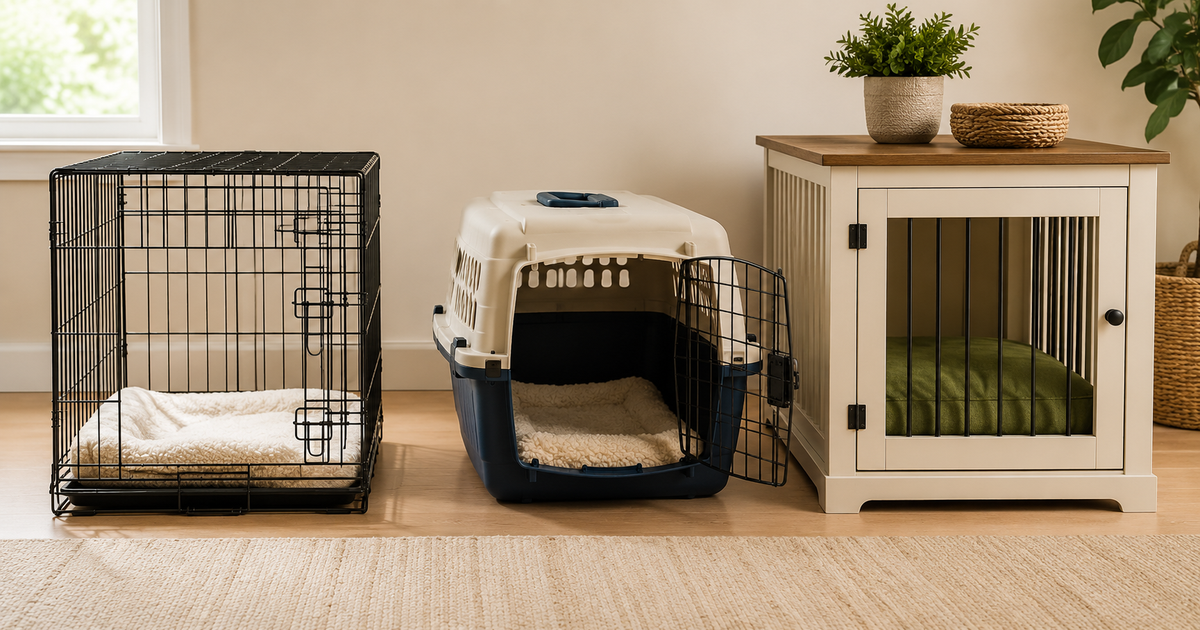
Comparison of different puppy crate styles side by side

This post contains affiliate links. If you buy through one, we may earn a commission at no extra cost to you. See our Affiliate Disclosure for details.

Written by the Puppy Tackle team — we’ve spent time on the retail and Amazon marketplace side of the pet products industry before starting this site, and we bring that same “does this actually hold up” scrutiny to every pick here.

Our Puppy Starter Kit guide covers what to look for in a crate generally — a divider panel, decent airflow, and sizing that fits your puppy’s adult weight, not just their current size. The AKC’s step-by-step crate training guide is a solid reference on the training method itself, and pairs with our own Potty & Crate Training guide. This post is the deeper product version: specific picks, by use case, with the actual trade-offs.


What We’re Judging On

Every crate here is scored against four things: does it have a divider panel (so it grows with your puppy instead of getting replaced), is it actually easy to clean, does it hold up to a determined chewer or scratcher, and is the price fair for what you get. We’re not testing based on looks — a crate that photographs well but falls apart in six months isn’t a real pick.


Best Overall: Adjustable Wire Crate With Divider Panel

This is the crate most owners should start with. Wire construction means strong airflow, a divider panel means one purchase covers puppyhood through adulthood, and the open sides make it easy to keep an eye on your puppy without opening the door.

Good for: most puppies, most homes, especially if the crate will live somewhere with regular foot traffic.

Trade-off: less “den-like” than a plastic crate, which can matter for an especially anxious puppy in the first few weeks.

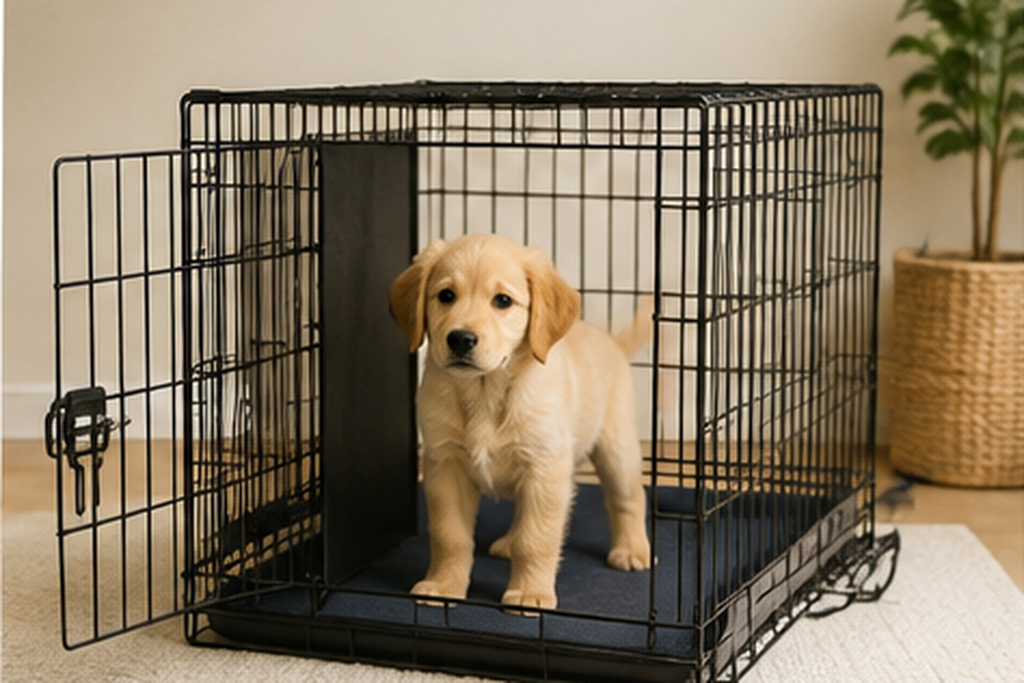
Adjustable wire crate with divider panel

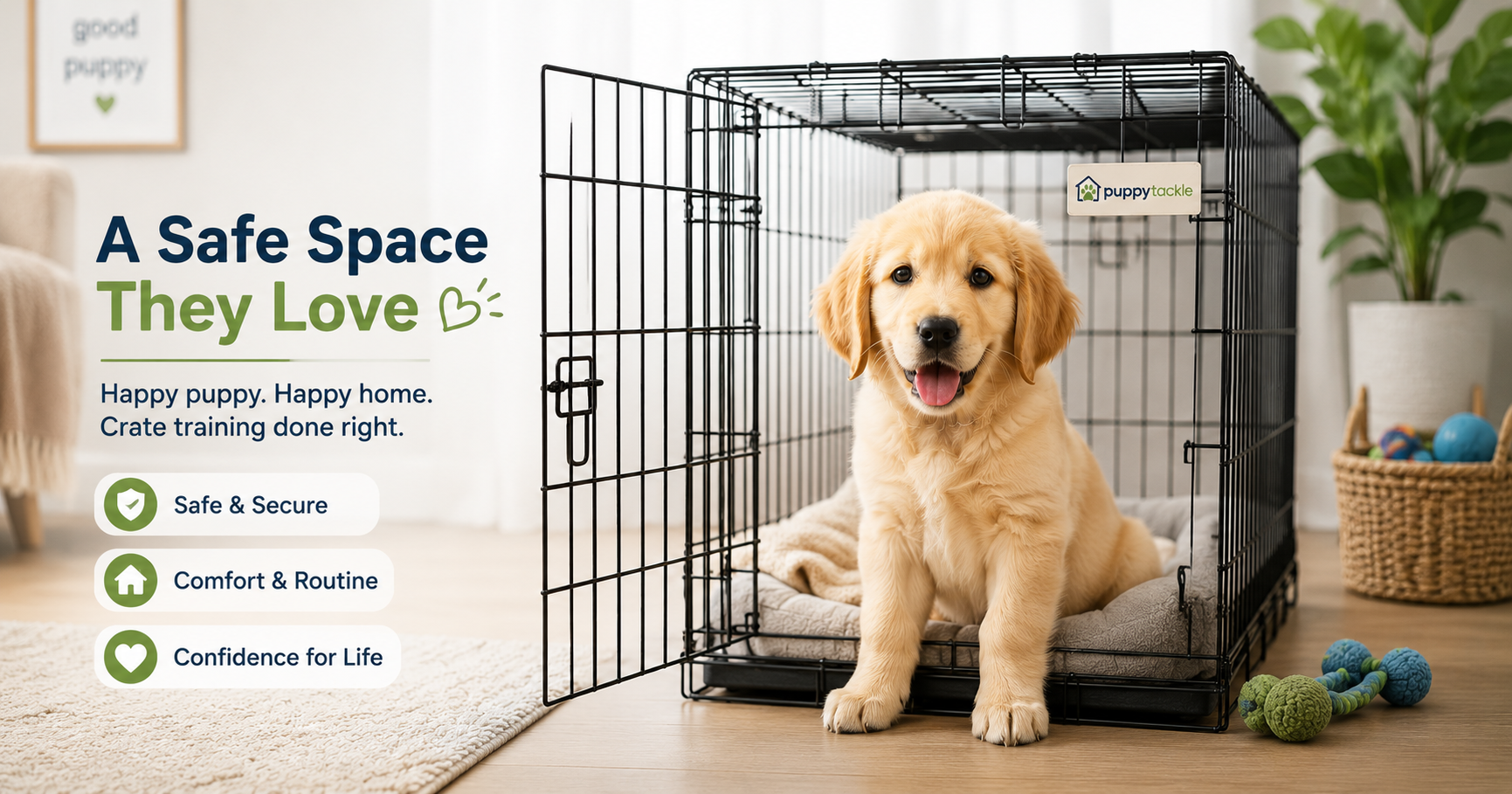
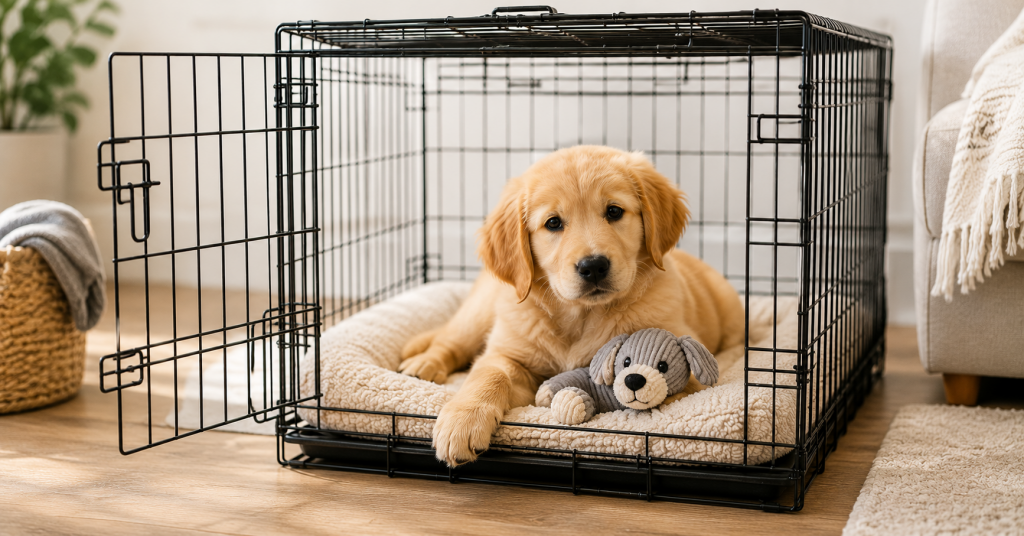
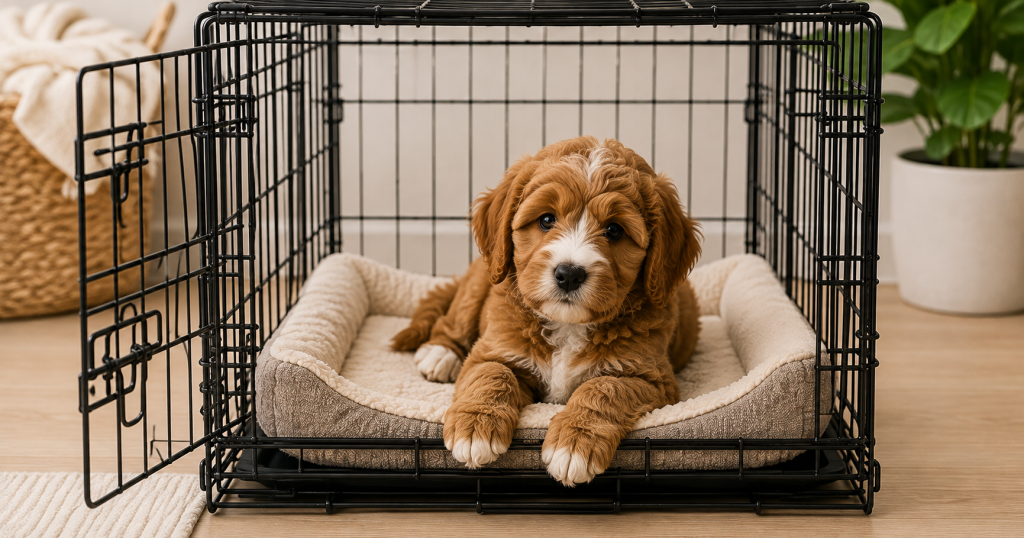
Puppy inside a wire crate with a divider panel

Best for Anxious Puppies: Plastic Den-Style Crate

The enclosed sides create a more cave-like, secure feeling, which can help a genuinely nervous puppy settle faster than an open wire crate. It’s also the crate you’ll want if you’re planning any air travel later, since most airline-approved carriers are built on this style.

Good for: puppies who seem stressed or overstimulated in an open wire crate; households planning to fly with their dog eventually.

Trade-off: less airflow than wire, and sizing up as your puppy grows usually means buying a second one rather than adjusting a divider.

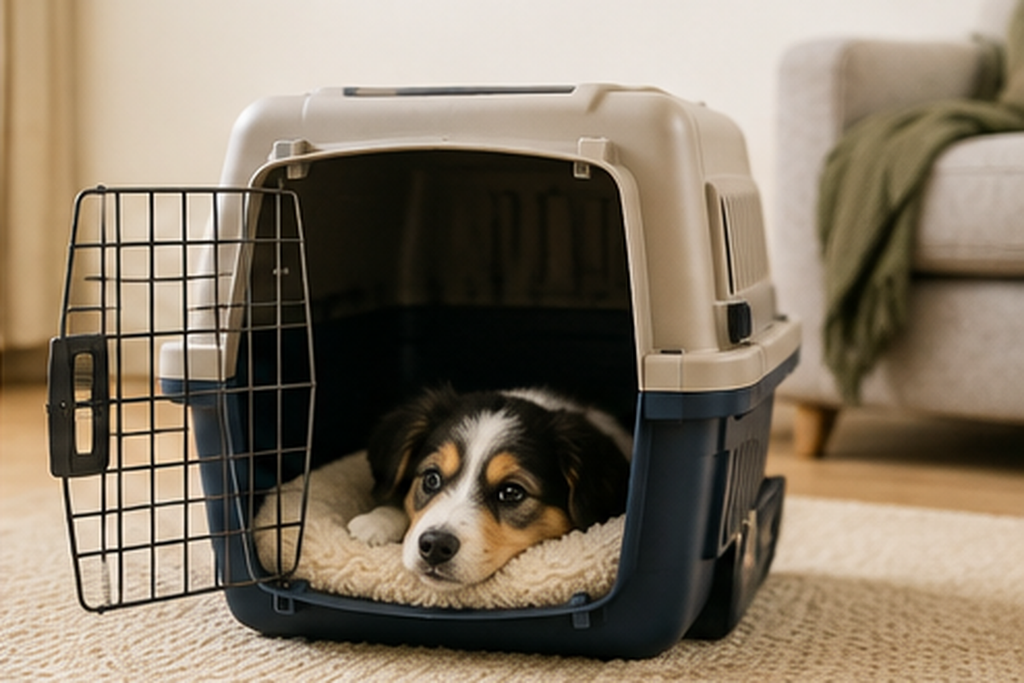
Plastic den-style travel crate

Puppy settled calmly inside a plastic den-style travel crate


Best Budget Pick: Basic Wire Crate (No Frills)

If you’re not sure yet whether crate training will click for your specific puppy, or you’re working with a tight starter budget, a basic wire crate without the divider panel or extra features does the core job. You’ll likely outgrow it faster, but it’s a reasonable way to start.

Good for: first-time owners testing the waters, or anyone prioritizing a lower upfront cost.

Trade-off: no divider panel means you’re likely buying a second crate as your puppy grows into an adult-size dog.

Basic wire crate


Best for Small Spaces: Furniture-Style Crate

Built to double as an end table or media stand, this style is worth the higher price if the crate needs to live in a living room or shared space where a standard wire crate feels visually intrusive.

Good for: apartments, small breeds, anyone who wants the crate to blend into the room instead of standing out.

Trade-off: costs more, and most furniture-style crates don’t include a divider panel, so sizing correctly from the start matters more here.

Furniture-style dog crate


Sizing: The Part Most People Get Wrong

Size for your puppy’s expected adult weight, not their current size — this is exactly why the divider panel matters on wire crates. A crate that’s too large defeats the den effect that makes potty training work; your puppy should be able to stand, turn around, and lie down comfortably, with a little room to spare, not a whole extra room to wander and use as a bathroom.


How Long Can a Puppy Actually Stay Crated?

This is the question that decides whether a crate helps or backfires, and it’s tied directly to bladder control, not convenience. As a rough guide: a young puppy can typically hold it for about one hour per month of age, plus one, during the day — so a 3-month-old is roughly a 4-hour daytime max, with more stretch overnight once their metabolism slows down. Crating longer than that regularly isn’t just uncomfortable, it teaches a puppy to go to the bathroom in the crate, which undoes the entire point of using one. Our Potty & Crate Training guide has the full age-by-age schedule if you want the specifics beyond this rule of thumb.


What This Actually Costs

A basic wire crate typically runs $30-$60, while a divider-panel version that lasts through adulthood runs $50-$120 depending on size — genuinely one of the better value purchases in a puppy’s first year, since it replaces something you’d otherwise buy twice. Furniture-style and heavy-duty travel crates run higher, often $150-$300+. For where this fits in the bigger first-year budget, see our full breakdown in How Much Does It Cost to Own a Puppy?


FAQ

Wire or plastic — which should I actually buy? Wire with a divider panel is the right default for most puppies and most homes. Reach for plastic specifically if your puppy seems unusually anxious in open spaces, or if air travel is realistically on the horizon.

Do I need to buy a second, bigger crate as my puppy grows? Not if you buy a wire crate with a divider panel — that’s the entire point of the feature. Without one, plan on sizing up once around the midpoint of their expected growth.

How do I know if the crate is the right size? Your puppy should be able to stand without crouching, turn around fully, and lie down stretched out, with only a little extra space — not enough room to sleep in one end and go to the bathroom in the other.

Is it cruel to crate a puppy? Not when it’s used correctly — as a positive, den-like space for reasonable stretches, not as a punishment or an all-day containment solution. A puppy that whines the first few nights is normal; a puppy that consistently panics in a properly introduced crate is worth discussing with your vet or a trainer.


This post is general information, not veterinary or behavioral advice. If your puppy shows signs of true crate-related distress — panting, drooling, or injuring themselves trying to escape — talk to your vet or a certified trainer rather than pushing through it.

Haven’t worked out the rest of your gear list yet? See our Puppy Starter Kit guide for the full starter setup.

Ready to actually use the crate? Our Potty & Crate Training guide covers the schedule and method.

Puppy Feeding Schedule: How Much and How Often to Feed by Age

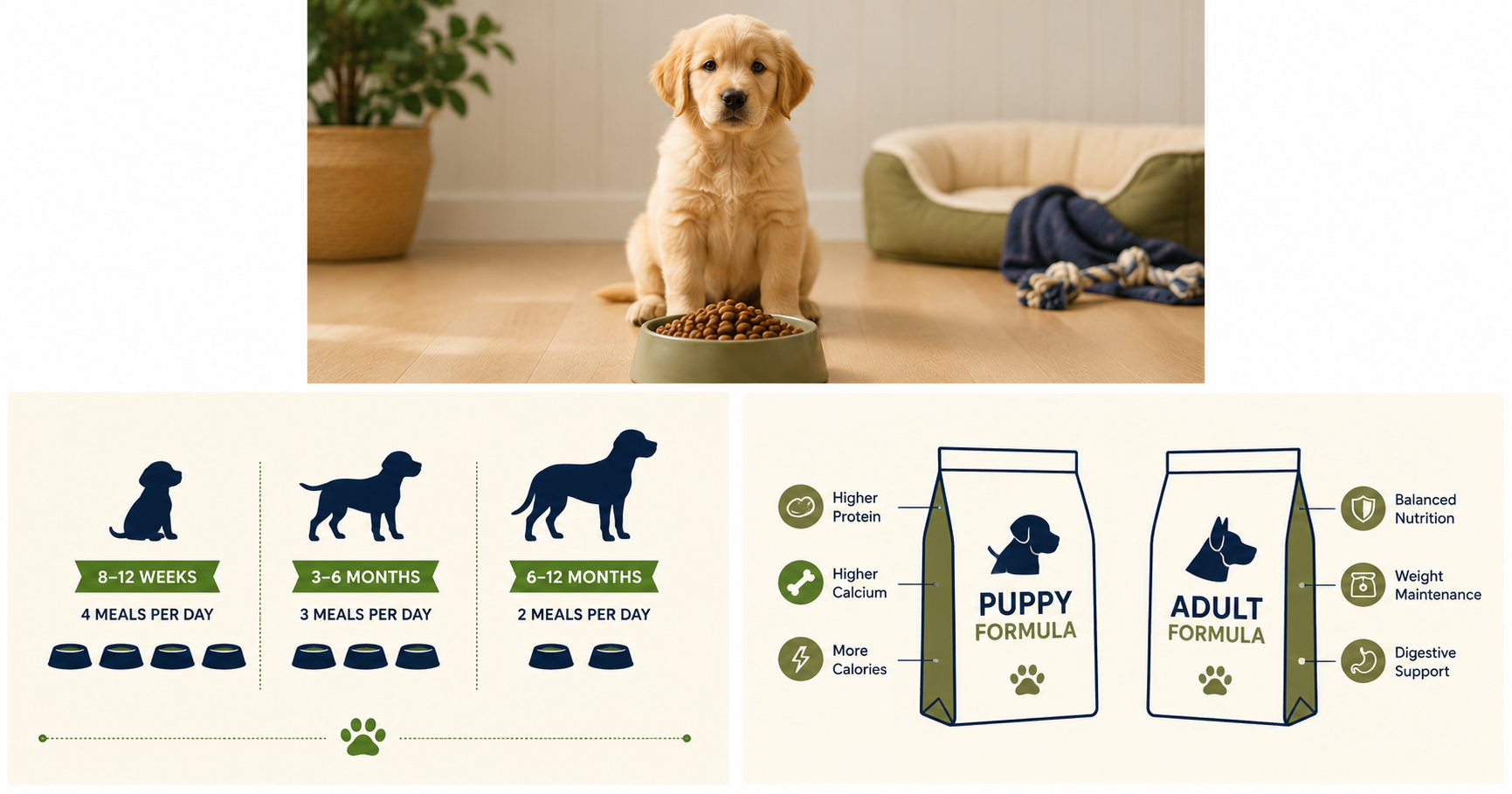
Puppy sitting in front of a full food bowl at feeding time

This post contains affiliate links. If you buy through one, we may earn a commission at no extra cost to you. See our Affiliate Disclosurefor details.

Written by the Puppy Tackle team — we’ve spent time on the retail and Amazon marketplace side of the pet products industry before starting this site, and we bring that same “does this actually hold up” scrutiny to every pick here.


Most feeding questions aren’t about what to feed — they’re about how much and how often, and the bag’s feeding chart on the back only gets you halfway there. It’s calibrated to an average dog, and your puppy isn’t average, they’re a specific weight, breed, and appetite. The WSAVA Global Nutrition Guidelines — the closest thing the veterinary world has to a shared standard on pet nutrition — back up the same core idea: feeding amounts should be adjusted to the individual animal’s body condition, not just a printed chart.

Here’s the actual schedule, by age, plus how to adjust it for your puppy instead of guessing.


Meals Per Day, By Age

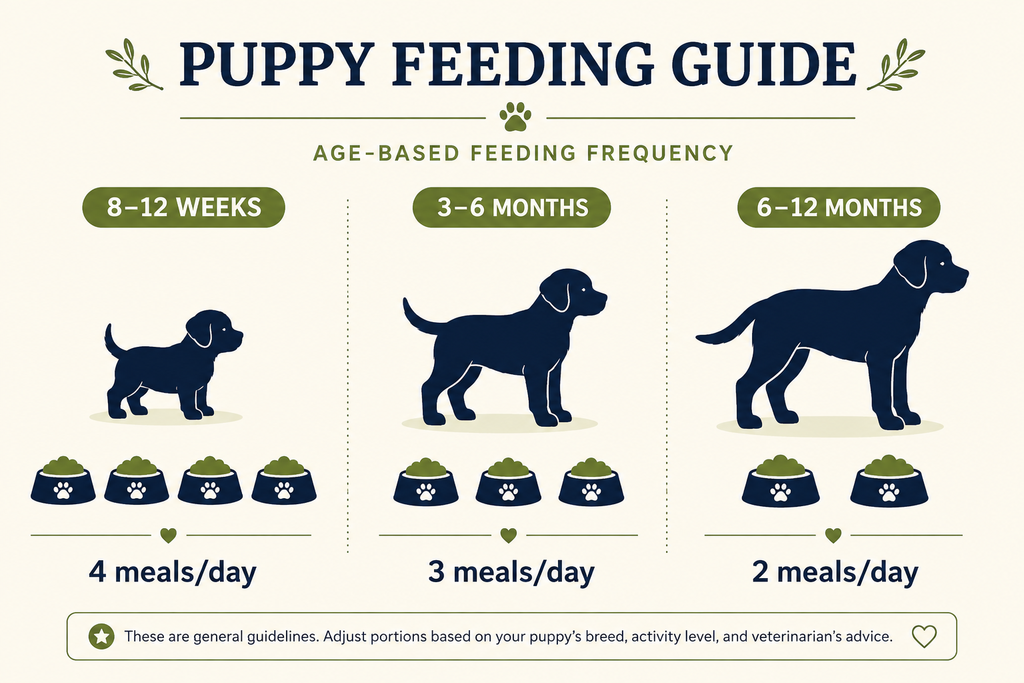
8-12 weeks: 4 meals a day. At this age a puppy’s stomach is small and their blood sugar can drop fast, so frequent small meals matter more than total volume.

3-6 months: 3 meals a day. This is also the window where teething ramps up, so don’t be surprised if appetite dips for a few days at a time — that’s normal.

6-12 months: 2 meals a day. Most puppies can comfortably transition to twice-daily feeding around 6 months, and this is the schedule they’ll likely keep into adulthood.

Puppy feeding frequency chart by age

How Much to Feed, By Weight

Portion size depends on your puppy’s current weight, expected adult weight, and the specific food’s calorie density — which is exactly why the bag’s chart is a starting point, not gospel.

A practical approach:

  • Start with the feeding chart on your specific food’s packaging (fresh food and kibble have very different calorie densities, so don’t mix charts between brands)
  • Split the daily total evenly across that day’s meals
  • Check your puppy’s body condition every 2 weeks — you should be able to feel their ribs without heavy pressure, but not see them

If your puppy is a fast, gulping eater, a slow-feeder bowl helps them actually register fullness instead of overeating in 90 seconds. We cover bowl recommendations in our Puppy Starter Kit guide.

Puppy-formula kibble by weight/breed size


Why “Puppy Formula” Actually Matters

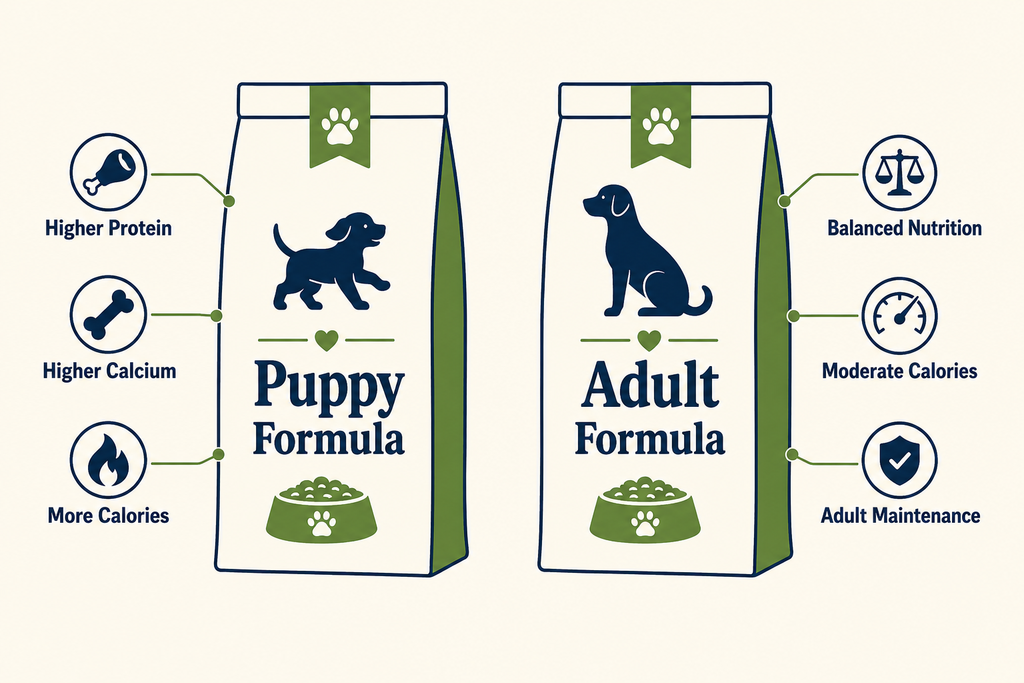
It’s not just marketing. Puppy-specific food is formulated with higher protein, fat, and calcium/phosphorus levels than adult food, to support the rapid bone and muscle growth happening in the first year. Feeding an adult formula too early can shortchange that growth, and feeding an oversized large-breed puppy a regular puppy formula (instead of a large-breed-specific one) can actually cause bones to grow too fast, which raises the risk of joint problems later. If you’re comparing fresh food against kibble more broadly, our Fresh Food vs. Kibble comparison goes deeper on that decision.

Comparing puppy formula and adult formula dog food labels


Adjusting the Schedule to Your Puppy

The age brackets above are a starting point, not a rule. Two puppies at 4 months can have very different appetites depending on breed size and activity level.

Signs you need to adjust portions up:

  • Ribs are easy to see, not just feel
  • Puppy seems constantly hungry between meals and is otherwise healthy
  • Noticeably low energy that improves after eating

Signs you need to adjust portions down:

  • You can’t feel ribs without pressing
  • Weight gain is faster than your vet’s growth expectations for the breed
  • Regular loose stool without another explanation

Talk to your vet at routine visits about whether your puppy’s weight is tracking appropriately for their breed — this is one of the easiest things to check at a normal appointment.


When to Switch to Adult Food

Most puppies transition to adult food between 12 and 18 months, with larger breeds often waiting closer to 18-24 months since they have a longer growth window. Switching too early can shortchange a still-growing puppy on the calories and nutrients they need.

Make the switch gradually over 7-10 days, mixing in increasing amounts of adult food, the same way you’d handle any food transition.

Fresh food subscription, portioned by weight


What Feeding Actually Costs

Food is one of the steadier monthly costs of puppy ownership rather than a one-time purchase, so it’s worth budgeting for rather than being surprised by. Expect roughly $300-$1,000 for the first year on kibble depending on breed size and brand, or noticeably more if you go with a fresh food subscription. See our full first-year breakdown, including food alongside vet costs and gear, in How Much Does It Cost to Own a Puppy?


FAQ

Should I free-feed (leave food out all day) instead of scheduled meals? Scheduled meals are almost always the better choice for puppies — free-feeding makes it harder to potty train on a schedule, since you won’t know when they last ate, and it makes weight gain harder to catch early.

My puppy skipped a meal. Should I worry? One skipped meal from a healthy, active puppy usually isn’t a concern — teething discomfort or excitement can cause this. Multiple skipped meals, or skipping paired with lethargy or vomiting, is worth a call to your vet.

Is it okay to feed a mix of kibble and fresh food? Yes — a lot of owners land here as a middle ground. Just make sure you’re accounting for both when calculating total daily calories, since fresh food is often more calorie-dense per cup than kibble.

Do large-breed puppies really need different food? Yes. Large and giant breed puppies grow fast enough that a regular puppy formula’s calcium and calorie levels can encourage growth that outpaces their joints and bones, raising the long-term risk of orthopedic issues. Look specifically for a “large breed puppy” formula on the label if your puppy is projected to be over roughly 50-70 lbs as an adult.


This post is general informational content, not veterinary or nutritional advice. Talk to your vet about your puppy’s specific feeding needs, especially if you have concerns about weight, growth rate, or appetite.

Still deciding between kibble and fresh food? See our Fresh Food vs. Kibble comparison.

Haven’t sorted your bowls and gear yet? Our Puppy Starter Kit guide covers what to look for.

Potty Training & Crate Training Your Puppy: The Complete Schedule

Puppy sitting at the open door of a training crate

This post contains affiliate links. If you buy through one, we may earn a commission at no extra cost to you. See our Affiliate Disclosure for details.

Potty training and crate training aren’t two separate projects — they’re the same project. A crate works because dogs instinctively avoid soiling where they sleep, which means it becomes your single best tool for teaching bladder control on a schedule you control, instead of cleaning up after the fact.

Here’s the actual schedule and method, not just “be patient” advice.


Why Crate Training Comes First

Before you can potty train effectively, your puppy needs a “den” — a space small enough that they won’t want to go to the bathroom in it, but comfortable enough that they’re not stressed being there. That’s the crate’s job.

How to introduce it right:

  • Never use the crate as punishment — it should always be a calm, positive space
  • Start with short stretches (10-15 minutes) while you’re home, so they don’t associate it with being left alone
  • Feed meals in or near the crate early on to build a positive association
  • Gradually extend crate time, including short periods when you leave the house

If you haven’t picked out a crate yet, our Puppy Starter Kit guide covers exactly what to look for, including the divider panel trick that saves you from buying two crates.

The Potty Training Schedule That Actually Works

The core rule: take your puppy out immediately after they wake up, after they eat or drink, and after playtime — these are the three moments a puppy is almost guaranteed to need to go.

Age-based bladder control guide (rough rule of thumb):

Puppy AgeApprox. Hours They Can Hold It
8-10 weeks1 hour
10-12 weeks2 hours
3-4 months3-4 hours
4-6 months4-5 hours
6+ months5-6 hours

A common rule of paw: a puppy can generally hold it for about one hour per month of age, plus one — so a 3-month-old puppy is roughly a 4-hour hold, max, during the day. Overnight, most puppies can stretch longer since their metabolism slows down.

A sample daily schedule for an 10-12 week old puppy:

  • 6:30am — wake up, straight outside
  • 7:00am — breakfast, then outside 15-20 min later
  • 9:00am — outside (after morning play/nap)
  • 11:00am — outside
  • 12:00pm — lunch, then outside 15-20 min later
  • 2:00pm — outside
  • 4:00pm — outside (after play/nap)
  • 5:30pm — dinner, then outside 15-20 min later
  • 7:30pm — outside
  • 9:30pm — last outside trip before bed

This looks like a lot because it is — the first few weeks are genuinely intensive. It gets dramatically easier as bladder control develops.


What to Do When Accidents Happen (Because They Will)

Never punish an accident after the fact — your puppy won’t connect the correction to something that happened minutes ago, it just teaches them you’re unpredictable. This lines up with the AVSAB position on humane, reward-based training, which found no evidence that punishment-based methods work better than reward-based ones. Instead:

  • If you catch them mid-accident, calmly interrupt and take them outside immediately
  • Clean the spot with an enzymatic cleaner, not a regular household cleaner — regular cleaners don’t fully remove the scent markers that draw a puppy back to the same spot (we cover this in the Puppy Starter Kit guide)
  • Go back to a tighter supervision schedule for a few days if accidents start increasing — it usually means you’ve given too much freedom too soon

Common Mistakes That Slow This Down

Inconsistent schedule. Potty training runs on predictability. A schedule that changes every day confuses the pattern you’re trying to build.

Too much freedom, too early. A puppy who has full run of the house before they’re reliably trained will find a corner you don’t check often. Use baby gates or a leash tether indoors during the early weeks to keep them in sight.

Punishing after the fact. Covered above, but worth repeating — it doesn’t work and can create anxiety around going to the bathroom in front of you at all, including outside.

Skipping the overnight routine. A last-call trip right before bed and a first-thing trip the moment they wake up are non-negotiable, especially in the first month.


When to Bring in Extra Help

If you’re past the 4-5 month mark and still struggling significantly, or if training in general — not just potty — feels harder than it should, a structured training program can help more than piecemeal YouTube videos. Brain Training for Dogs is a well-regarded structured, at-home program that goes beyond potty training into obedience and behavior work, and it’s worth a look if you want a guided curriculum rather than figuring it out solo.

Brain Training for Dogs


FAQ

How long does potty training usually take? Most puppies are largely reliable by 4-6 months with consistent training, though full reliability (including holding it through a full night or a long car ride) can take up to a year.

Should I use potty pads instead of going outside? Pads can work as a bridge, especially in apartments or bad weather, but they can also confuse the “only go outside” message. If you use them, be consistent about phasing them out once your puppy is a bit older.

Is it normal for training to regress? Yes — regressions during teething, a schedule change, or a stressful event (new home, new pet) are common and not a sign you’re doing something wrong. Go back to a tighter schedule for a week or two and it usually resolves.


Haven’t sorted your gear yet? Our Puppy Starter Kit guide covers the crate, enzymatic cleaner, and everything else this schedule depends on.

Feeding times and potty times are linked — see our Fresh Food vs. Kibble guide if you haven’t settled on a feeding routine yet.

Want the full picture, including gear, feeding, and health costs? See our Complete New Puppy Checklist.

How Much Does It Cost to Own a Puppy? The Real First-Year Numbers

Puppy at the vet during a checkup

This post contains affiliate links. If you buy through one, we may earn a commission at no extra cost to you. See our Affiliate Disclosure for details.

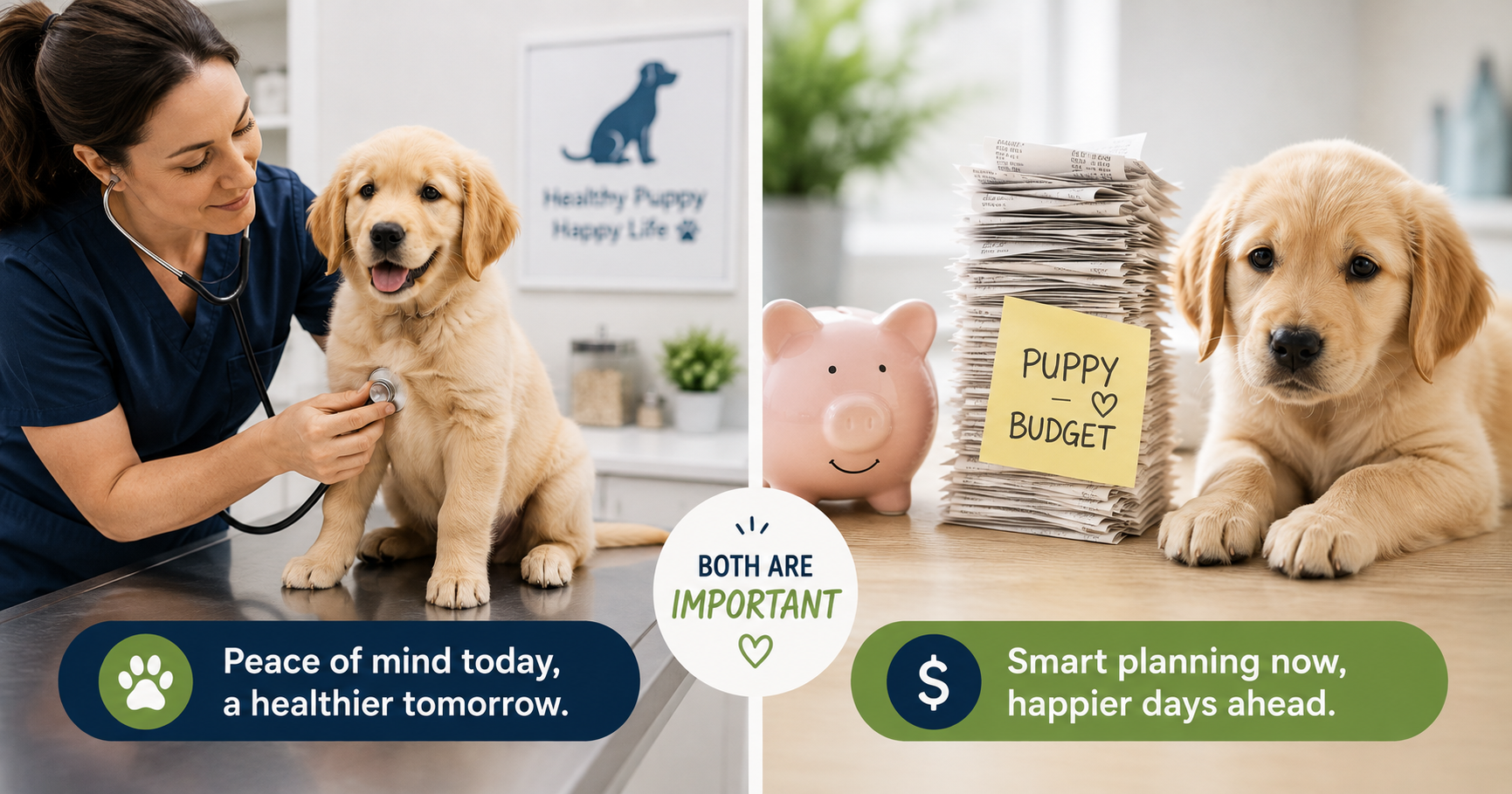
The sticker price of a puppy — whether it’s $0 from a rescue or $2,000 from a breeder — is almost never the real cost. The real cost shows up in the first twelve months, in vet bills, food, gear, and the one expense most new owners don’t budget for at all: what happens if something goes wrong.

Here’s the honest breakdown, including where insurance actually fits in.


Year One Cost Breakdown (Rough Estimate)

CategoryLowHigh
Initial vet visit + vaccine series$200$500
Spay/neuter$150$700
Food (first year)$300$1000
Gear (crate, leash, bowls, etc.)$150$300
Training (classes or app-based)$0$300
Pet insurance (if started early)$300$800
Grooming (if needed)$0$300
Total (excluding purchase/adoption price)~$1100~$3,900

That range is wide because it depends heavily on breed size, where you live, and whether anything unexpected happens — which brings up the part most people underestimate.

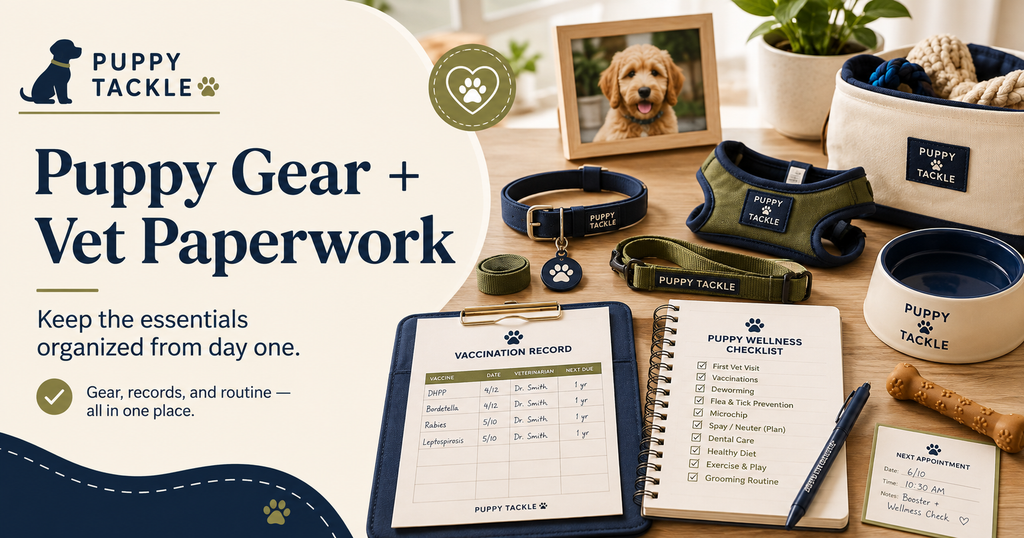
Puppy gear and vet paperwork laid out on a table

The Cost Nobody Budgets For: Emergencies

A routine first year is one thing. An emergency is another. Common puppy emergencies — swallowing something they shouldn’t have, a broken bone from rough play, an unexplained illness — routinely run $1,500-$5,000+ at an emergency vet, and that’s before anything requiring surgery.

This is the actual argument for pet insurance: not that your puppy will definitely need it, but that if they do, the bill arrives all at once and doesn’t wait for payday.


How Pet Insurance Actually Works

Pet insurance typically works on a reimbursement model — you pay the vet bill upfront, submit a claim, and get reimbursed a percentage (commonly 70-90%) after your deductible, up to your plan’s annual limit.

Two main plan types:

  • Accident-only — cheaper, covers injuries (broken bones, swallowed objects, etc.) but not illness
  • Accident + illness (comprehensive) — costs more monthly but covers a much wider range, including chronic conditions

Why timing matters: pet insurance doesn’t cover pre-existing conditions. The earlier you enroll — ideally right when you bring your puppy home — the more coverage you actually get, because nothing has had a chance to show up on a vet record yet.

Compare pet insurance plans or Get a pet insurance quote


Is It Actually Worth It?

This is a real financial decision, not a one-size-fits-all answer — the right call depends on your emergency savings, your risk tolerance, and your specific breed’s known health risks. A few honest questions to run through:

  • Could you comfortably cover a surprise $3,000-$5,000 vet bill out of pocket right now? If not, insurance (or a dedicated pet emergency fund) is worth serious consideration.
  • Is your breed prone to known issues? Some breeds carry higher lifetime risk for hip dysplasia, certain cancers, or breathing issues — worth factoring in.
  • Would a self-funded emergency fund work better for you? Some owners skip insurance and instead set aside a fixed monthly amount into a separate savings account earmarked only for vet emergencies. It’s a legitimate alternative — just requires discipline to actually leave it untouched.

There’s also a savings-club option worth knowing about, separate from insurance — programs like PetAssure work more like a discount card, reducing your bill at participating vets by a flat percentage rather than reimbursing you after the fact. It’s not a substitute for insurance against a major emergency, but it can meaningfully lower routine costs.

Vet discount savings plan


Ongoing Monthly Costs After Year One

Once the first-year setup costs are behind you, ongoing monthly costs typically settle to:

  • Food: $30-$80/month depending on size
  • Insurance (if enrolled): $35-$90/month depending on plan and breed
  • Routine vet care (averaged): $20-$40/month
  • Miscellaneous (toys, treats, grooming): $20-$50/month

FAQ

Is pet insurance worth it for a healthy puppy? The value isn’t about your puppy being unhealthy now — it’s about being covered if something changes later. Enrolling while they’re healthy is exactly when you get the broadest coverage, since pre-existing conditions aren’t covered once they show up on record.

What’s the difference between insurance and a discount plan like PetAssure? Insurance reimburses you after a vet visit, particularly for larger unexpected expenses. A discount plan reduces the bill upfront at the time of service, but doesn’t cover you against a major emergency the way insurance does. They solve different problems and some owners use both.

When should I enroll in insurance? As early as possible — ideally the same week you bring your puppy home, before any conditions have a chance to appear on a vet record.


Not sure what gear to prioritize before the vet visit and beyond? See our Puppy Starter Kit guide.

Curious how food choice affects long-term health and cost? See our Fresh Food vs. Kibble comparison.

Want the full picture, including gear, feeding, and training? See our Complete New Puppy Checklist.


This post is for general informational purposes and isn’t financial, insurance, or veterinary advice. Talk to your vet about your puppy’s specific health needs, and compare insurance providers directly for exact plan terms and pricing.

Fresh Food vs. Kibble for Puppies: Which Is Actually Better?

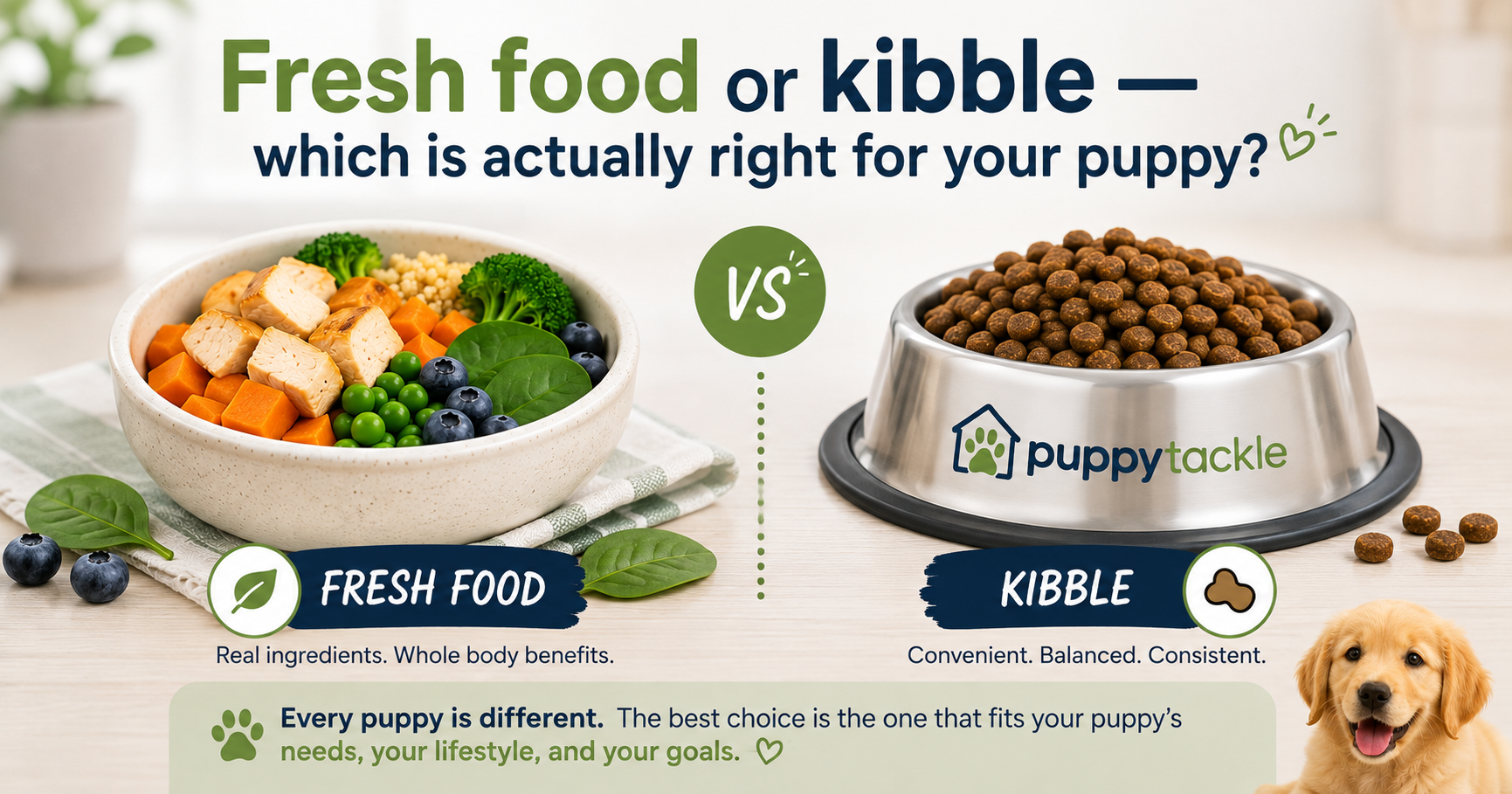
Bowl of kibble next to a portion of fresh dog food

This post contains affiliate links. If you buy through one, we may earn a commission at no extra cost to you. See our Affiliate Disclosure for details.

Walk into any pet store or scroll any dog forum and you’ll find someone with a strong opinion on this. Kibble people think fresh food is an overpriced trend. Fresh food people think kibble is barely food at all. Neither extreme is telling you the whole truth. Here’s the actual comparison, without the brand bias — what each option really is, what it costs, what it does well, and how to decide what’s right for your puppy and your budget. So what’s better: fresh food vs kibble for puppies?


What Kibble Actually Is

Kibble is cooked, extruded, and dried into a shelf-stable pellet. That process is exactly why it’s affordable and convenient — it can sit in a bag for months without refrigeration, it’s easy to portion, and it’s available everywhere from grocery stores to Chewy.

Where kibble does well:

  • Cost — significantly cheaper per feeding than fresh options
  • Shelf life and convenience — no fridge/freezer space, no meal prep
  • Consistency — same formula, same nutrition, every bag
  • Dental benefit — the crunch can help reduce tartar buildup somewhat (though it’s not a substitute for actual dental care)

Where it falls short:

  • Quality varies enormously by brand — “kibble” isn’t one category, it spans everything from budget grocery-store bags to premium vet-formulated lines
  • Lower moisture content, which matters more for breeds prone to urinary issues
  • Some cheaper formulas rely heavily on fillers and byproducts rather than whole ingredients
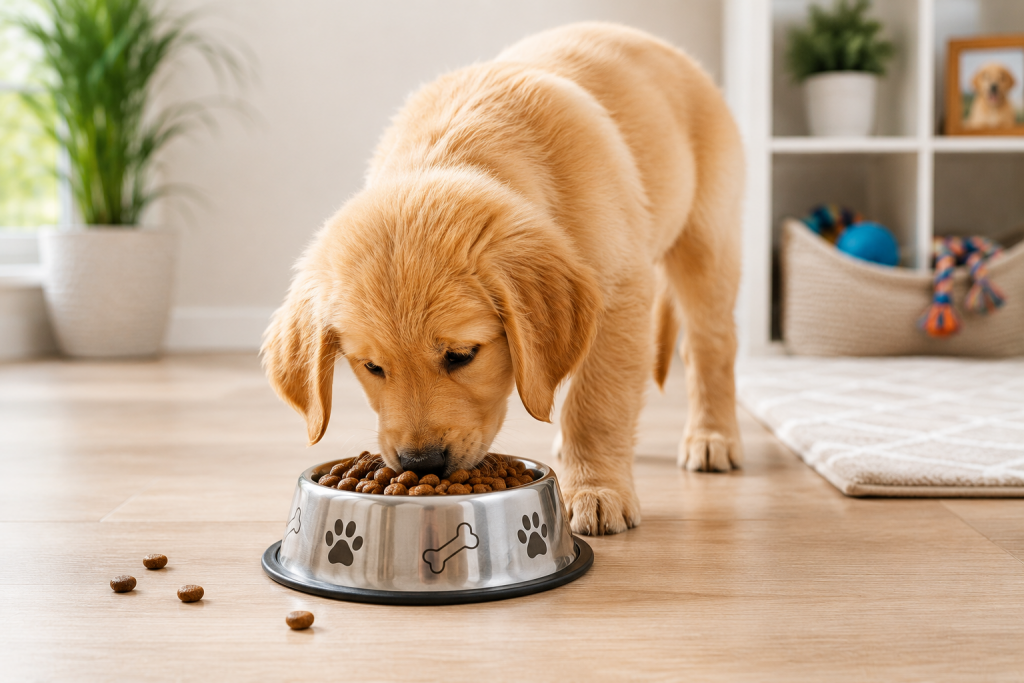
Puppy eating kibble from a bowl"

What “Fresh Food” Actually Means

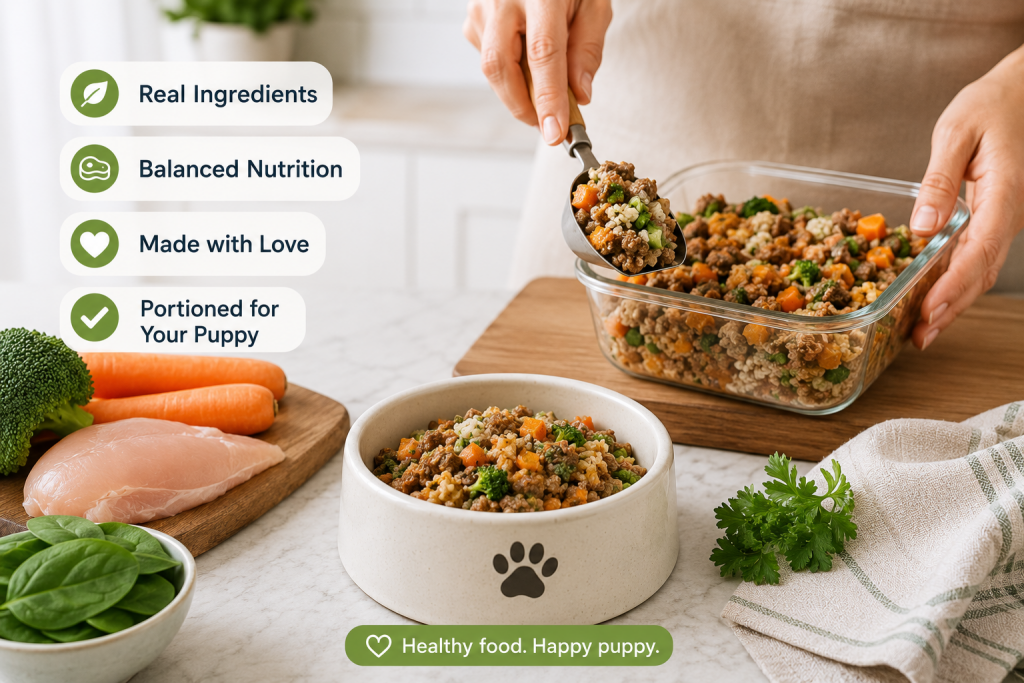
“Fresh food” usually refers to refrigerated or frozen meals made with whole-food ingredients, often delivered as a subscription (this is where brands like Ollie operate) — portioned specifically for your dog’s weight and life stage.

Where fresh food does well:

  • Ingredient transparency — you can usually see and recognize everything in it
  • Portion-controlled for your specific puppy, which takes the guesswork out of feeding
  • Higher moisture content, which some dogs digest more easily
  • Often better for dogs with sensitive stomachs or picky eating habits

Where it falls short:

  • Cost — this is the big one. Fresh food subscriptions typically run several times the cost of kibble per month
  • Requires fridge or freezer space
  • Less convenient for travel or if you’re inconsistent with reordering
  • Not necessary for every dog — a healthy puppy on a quality kibble isn’t nutritionally “missing out”
Fresh dog food meal being portioned into a bowl"

The Nutrition Question, Honestly

This is where the internet gets loud and the actual answer is boring: a nutritionally complete kibble and a nutritionally complete fresh food can both support a healthy puppy. “Complete and balanced” (look for that phrase, or an AAFCO statement on the label) is the real marker of quality — not whether the food is dry or fresh.

Where fresh food tends to have a real edge is with dogs who have specific sensitivities, picky eaters who won’t reliably eat kibble, or owners who want more control over exact ingredients. Where kibble holds its own is that a well-formulated one is a completely legitimate, complete diet — not a compromise.

This is general information, not veterinary advice — if your puppy has a diagnosed sensitivity, allergy, or health condition, talk to your vet before switching foods or formats.


Cost Comparison (Roughly)

For a medium-size puppy, expect:

Monthly Cost (approx.)
Budget kibble$20-$40
Premium kibble$40-$90
Fresh food subscription$60-$300+

The gap is real, and it’s the single biggest factor in this decision for most households — not a nutrition gap, a budget one.

Premium puppy kibble or Fresh food subscription


So Which Should You Choose?

Kibble makes sense if: you want the most cost-effective option, your puppy eats it fine, and you’d rather put budget elsewhere (training, gear, insurance).

Fresh food makes sense if: your puppy has a sensitive stomach or is a picky eater, you have room in the budget, or ingredient transparency matters enough to you to justify the cost.

A middle ground a lot of owners land on: primarily kibble, with fresh food used as a topper or occasional addition — you get the cost efficiency of kibble with some of the palatability/moisture benefit of fresh food.


FAQ

Is fresh food actually healthier than kibble? Not automatically — a complete and balanced kibble meets your puppy’s nutritional needs. Fresh food’s advantages are more about ingredient transparency, moisture content, and palatability than a guaranteed health outcome.

Can I switch between the two? Yes, but do it gradually over 5-7 days, mixing increasing amounts of the new food with the old, to avoid stomach upset.

What if my puppy won’t eat kibble at all? Some puppies are genuinely picky. If a puppy is consistently refusing to eat, that’s worth a vet check first — but if they’re just being selective, a fresh food option (even used as a topper) often solves it.


Figuring out the rest of the feeding picture — how much, how often, and when to switch to adult food? Check out our Complete New Puppy Checklist for the full feeding timeline.

Feeding times also drive your potty schedule — see our Potty & Crate Training guide for how the two connect.

Getting your gear sorted first? See our Puppy Starter Kit guide.

Puppy Starter Kit: Everything You Need Before Bringing Your Puppy Home

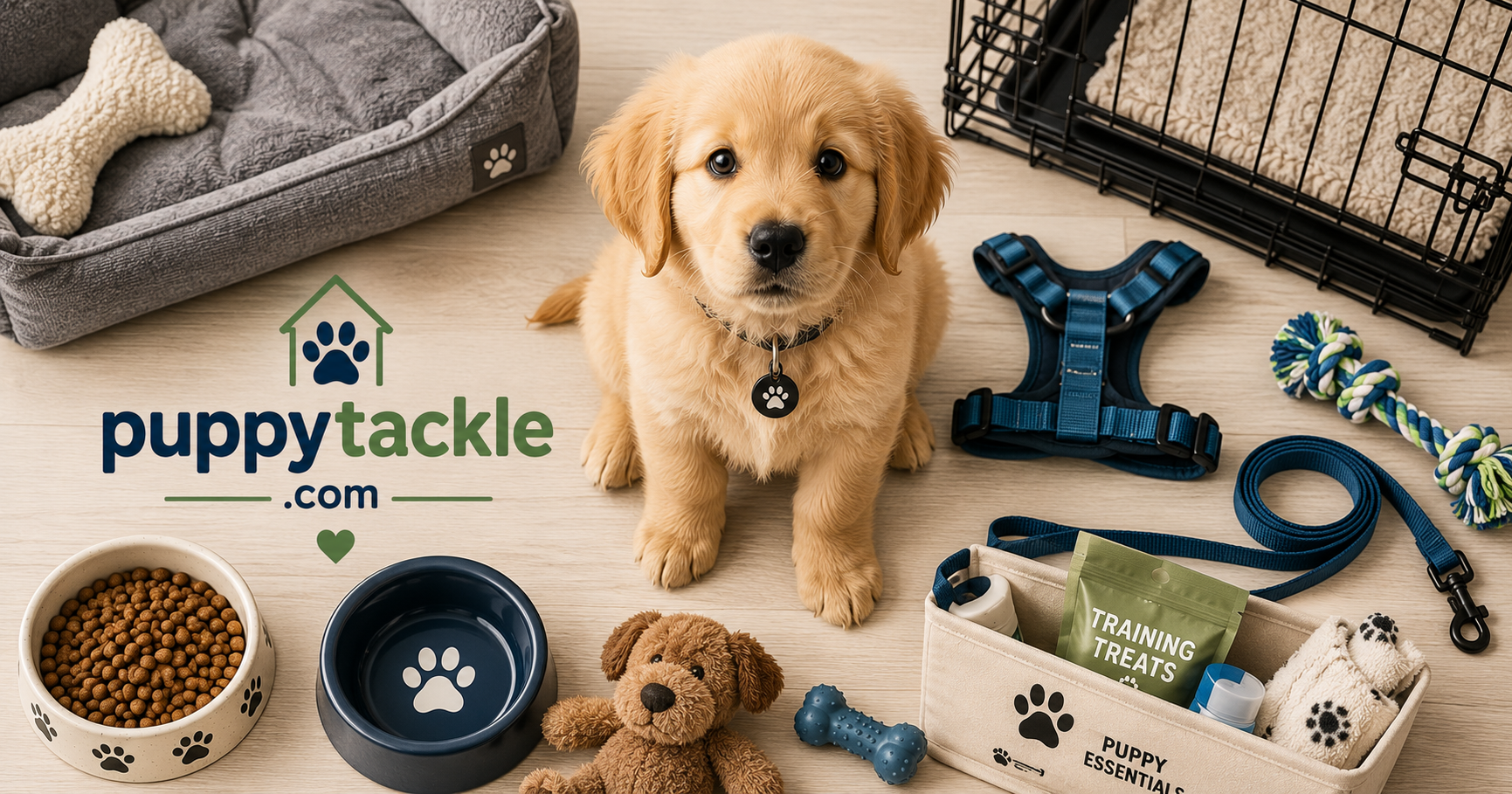
Puppy starter kit flat lay with crate, harness, bowls, and toys

This post contains affiliate links. If you buy through one, we may earn a commission at no extra cost to you. See our Affiliate Disclosure for details.

You brought home a puppy, or you’re about to. Either way, you’re standing in the middle of a pet store (or scrolling Amazon at 11pm) staring at forty different crate sizes, seventeen “best” harnesses, and a wall of chew toys, trying to figure out what you actually need versus what’s just marketing.

Here’s the truth: most new owners either buy way too much — stuff that ends up in a closet by week three — or they skip something important because nobody told them it mattered. This list fixes both problems. It’s everything you actually need, organized by category, with a plain answer on why each item matters and what to look for.

No filler. No 47-item “ultimate checklists” padded with things you’ll never use. Just the real starter kit.


The Crate

Puppy resting inside a wire crate with a soft bed

A crate isn’t punishment — it’s your puppy’s den, and it’s the fastest way to make potty training and separation anxiety manageable. Dogs instinctively avoid soiling where they sleep, which is exactly why crate training works.

What to look for: a crate with a divider panel, so you buy one crate that grows with your puppy instead of replacing it three times in their first year. Wire crates give better airflow; plastic crates feel more den-like and travel better.

Skip: decorative crates that look nice but are too small for an adult dog, or crates without a divider — you’ll be buying a second one in six months.

ADJUSTABLE WIRE CRATE WITH DIVIDER PANEL


Bed

Your puppy will chew this. Accept it now. Don’t buy the expensive orthopedic bed until they’re past the teething phase (usually 6-8 months).

What to look for: a washable cover, chew-resistant fabric, and a size that matches your crate if you’re using it inside one.

Skip: memory foam beds for young puppies — they’re pricey and won’t survive week one of teething.

Washable crate-size puppy bed


Food & Water Bowls

Simple, but a few things actually matter here.

What to look for: stainless steel over plastic — plastic can harbor bacteria and some puppies develop chin acne from it. If your puppy is a fast, gulping eater, a slow-feeder bowl helps prevent bloat and vomiting.

Skip: bowls that are too deep for a small breed puppy’s snout, and anything not dishwasher-safe (you will not want to hand-wash a dog bowl twice a day).

Stainless Steel Bowl Set or Slow Feeder Bowls

For a full breakdown of what and how much to feed, see our Fresh Food vs. Kibble guide.

Collar, ID Tag & Harness

Puppy wearing an adjustable harness on a walk"

This is the one category where cutting corners actually matters. A scared or excited puppy can slip a collar shockingly fast, and a lost puppy without ID is a nightmare.

What to look for: a properly fitted flat collar for everyday wear and ID, plus a harness for walks — harnesses reduce strain on a puppy’s developing neck and trachea and give you better control if they lunge. Look for adjustable sizing since puppies grow fast.

Skip: retractable leashes for puppies (they teach pulling, not loose-leash walking) and collars without a quick-release buckle.

Adjustable puppy harness and Basic ID tag with engraving

If you’re dealing with a puppy that pulls hard, bolts, or needs a containment solution like a wireless fence as they get older, PetSafe makes some of the most trusted gear in this category — worth a look once you’re past the basics.

PetSafe Training Gear


Chew Toys (Actually Puppy-Safe Ones)

Puppy chewing on a puppy-safe teething toy

Teething starts around 3-4 months and it is relentless. The goal isn’t to stop the chewing — it’s to redirect it before your shoes become the target.

What to look for: a rotation of textures — something rubbery, something rope-based, something for freezing (frozen textured toys soothe sore gums). Rotate 2-3 toys at a time so nothing gets boring.

Skip: anything with small parts that can be chewed off and swallowed, and rawhide, which can pose a choking/blockage risk for puppies especially.

Puppy teething toy set


Potty Training Supplies

Whether you’re doing pads, grass patches, or straight to outside, you need a real plan here — see our full Potty & Crate Training Guide for the schedule and method. But regardless of method, you need:

Enzymatic cleaner — regular cleaners don’t fully remove the scent markers that make a puppy return to the same spot. This is not optional if you want potty training to actually stick.

Poop bags — buy in bulk now, you’ll go through more than you think.

Enzymatic pet stain/odor remover and Bulk poop bags


Grooming Basics

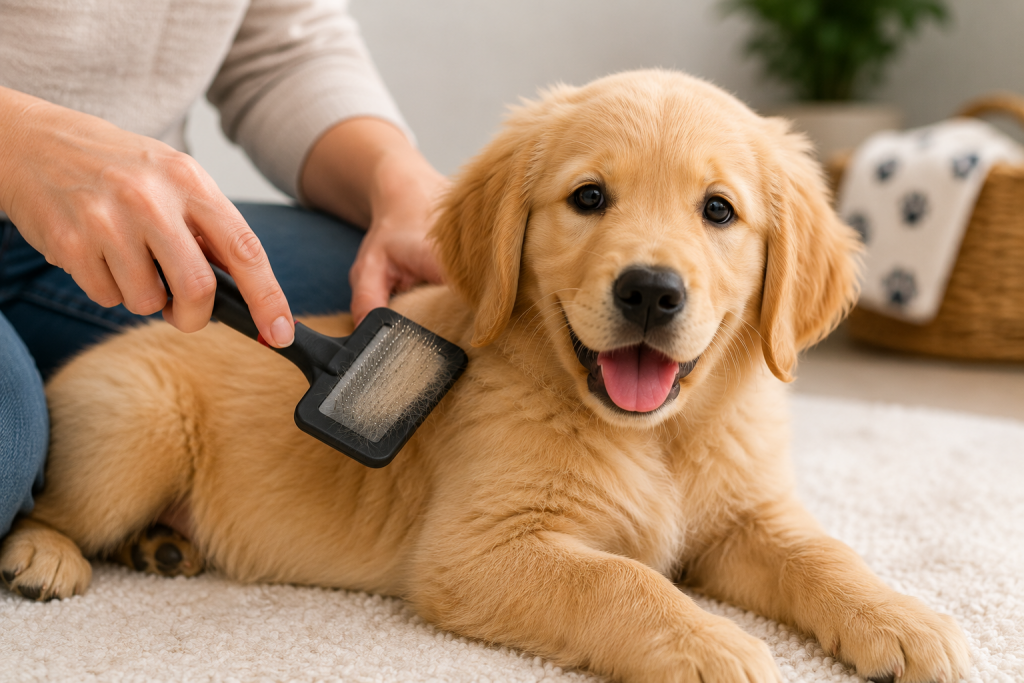
Puppy being groomed with a slicker brush

Even short-haired breeds need a basic grooming kit, and starting early gets your puppy comfortable with being handled — which makes vet visits and nail trims dramatically easier later.

What to look for: a slicker brush appropriate for your puppy’s coat type, puppy-safe nail clippers or a grinder, and a puppy shampoo that won’t dry out their skin.

Skip: human shampoo (wrong pH for dog skin) and adult-dog nail clippers, which are often too large to use safely on tiny puppy nails.

Puppy grooming kit (brush, clippers, shampoo)


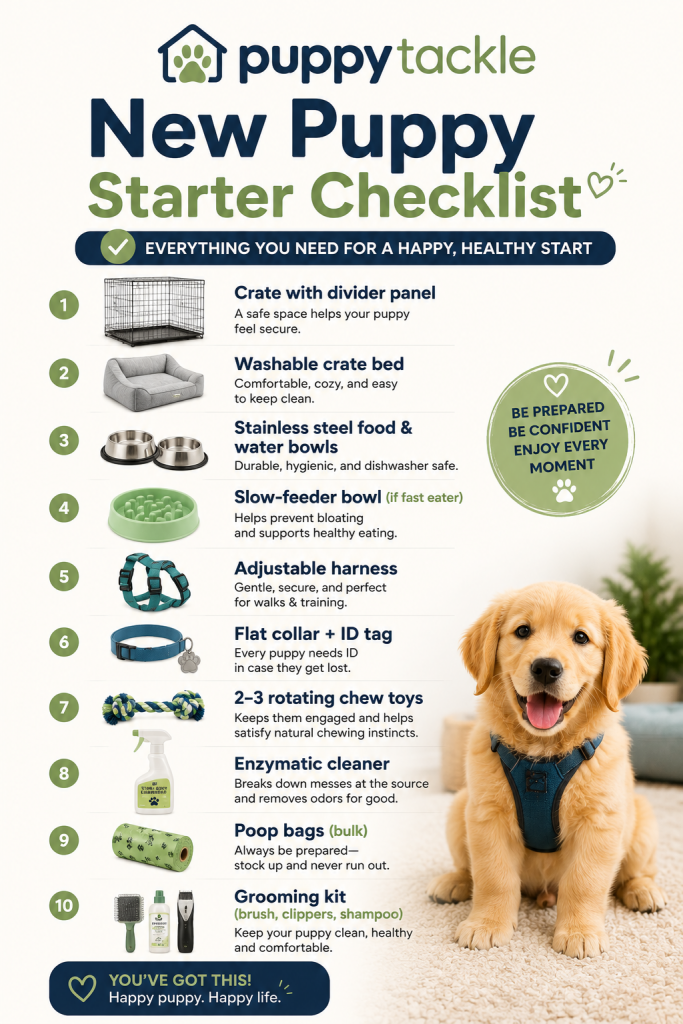
The Quick-Reference List

Puppy starter kit checklist — crate, bowls, harness, toys, grooming supplies

FAQ

Do I need all of this before day one? No. Crate, bowls, collar/ID, and a couple of chew toys cover day one. Grooming tools and a bigger toy rotation can wait a week or two.

How much should I expect to spend on starter gear? Budget roughly $150-$300 for a full setup depending on brand choices and puppy size — the crate and harness are usually the biggest line items.

What’s the one thing people forget to buy? Enzymatic cleaner. Nobody thinks about it until they need it, and by then the smell has already set into the carpet.


Want the full picture before puppy comes home? Check out our Complete New Puppy Checklist for everything beyond gear, including feeding, training, and what that first vet visit actually costs.

Curious how gear costs fit into the bigger first-year budget? See our Cost to Own a Puppy guide for the full breakdown.

Verified by MonsterInsights